---
title: Your Benefits Strategy May Have a Coordination Problem
description: Is your benefits strategy working against itself? Discover hidden coordination gaps that may be costing your company money.
image: https://blog.dspins.com/hubfs/AI-Generated%20Media/Images/The%20image%20depicts%20a%20modern%20virtual%20conference%20setting%20showcasing%20a%20sleek%20digital%20interface%20on%20a%20laptop%20screen%20The%20background%20features%20a%20professional%20w-1.png
---
[](https://www.dspins.com/)
- [Insurance Solutions](https://www.dspins.com/insurance-solutions/)
- [Business Insurance](https://www.dspins.com/business-insurance/)
- [Workers’ Compensation](https://www.dspins.com/business-insurance/workers-compensation-insurance/)
- [Directors and Officers Liability](https://www.dspins.com/business-insurance/directors-and-officers-liability-insurance/)
- [Employment Practice Liability](https://www.dspins.com/business-insurance/employment-practice-liability-insurance/)
- [See All](https://www.dspins.com/business-insurance/)
- [Employee Benefits](https://www.dspins.com/employee-benefits/)
- [Group Health](https://www.dspins.com/employee-benefits/group-health-insurance/)
- [Group Dental](https://www.dspins.com/employee-benefits/group-dental-insurance/)
- [Group Vision](https://www.dspins.com/employee-benefits/group-vision-insurance/)
- [See All](https://www.dspins.com/employee-benefits/)
- [Insurance by Industry](https://www.dspins.com/business-insurance/insurance-by-industry/)
- [Contractor](https://www.dspins.com/business-insurance/insurance-by-industry/contractor-insurance/)
- [Manufacturer](https://www.dspins.com/business-insurance/insurance-by-industry/manufacturer-insurance/)
- [Financial Institution](https://www.dspins.com/business-insurance/insurance-by-industry/financial-institution-insurance/)
- [See All](https://www.dspins.com/business-insurance/insurance-by-industry/)
- [Personal Insurance](https://www.dspins.com/personal-insurance/)
- [Home](https://www.dspins.com/personal-insurance/home-insurance/)
- [Auto](https://www.dspins.com/personal-insurance/auto-insurance/)
- [Umbrella](https://www.dspins.com/personal-insurance/umbrella-insurance/)
- [See All](https://www.dspins.com/personal-insurance/)
- [Safety Consulting](https://www.dspins.com/safety-consulting/)
- [Service Center](https://www.dspins.com/service-center/)
- [Explore Policy Options](https://www.dspins.com/service-center/)
- [Report a Claim](https://www.dspins.com/service-center/report-a-claim/)
- [Request Auto ID Card](https://www.dspins.com/service-center/request-auto-id-card/)
- [Request a Certificate](https://www.dspins.com/service-center/request-certificate/)
- [Request a Bond](https://www.dspins.com/service-center/report-a-claim/)
- [Policy Review](https://www.dspins.com/service-center/policy-review/)
- [Request Policy Change](https://www.dspins.com/service-center/request-policy-change/)
- [Client Login](https://www.dspins.com/service-center/#client-login)
- [Custom Insurance Benchmarking](https://www.dspins.com/custom-insurance-benchmarking/)
- [About](https://www.dspins.com/service-center/)
- [About Our Agency](https://blog.dspins.com/About%20Our%20Agency)
- [Agency News](https://www.dspins.com/blog/category/agency-news/)
- [Meet Our Team](https://www.dspins.com/about-our-agency/meet-our-team/)
- [Read Our Reviews](https://www.dspins.com/about-our-agency/read-our-reviews/)
- [We Are Independent](https://www.dspins.com/about-our-agency/we-are-independent/)
- [Community Involvement](https://www.dspins.com/about-our-agency/community-involvement/)
- [Join Our Team](https://www.dspins.com/about-our-agency/join-our-team/)
- [Learn About Our Agency](https://www.dspins.com/about-our-agency/)
- Media
- [Blog](https://blog.dspins.com/)
- [Podcast](https://www.dspins.com/podcast/)
- [Events](https://info.dspins.com/events)
- [Contact](https://www.dspins.com/contact/)
- [Schaumburg, IL Office](https://www.dspins.com/contact/schaumburg-il-insurance/)
- [1900 E. Golf Road Suite 650 Schaumburg, IL 60173](https://www.dspins.com/contact/schaumburg-il-insurance/)
- [847-934-6100](tel:847-934-6100)
- [info@dspins.com](https://blog.dspins.com/info@dspins.com)
- [Review Us](https://www.dspins.com/contact/review-us/)
- [Refer Us](https://www.dspins.com/contact/refer-us/)
- [Contact](https://www.dspins.com/contact/)
[847-934-6100](tel:847-934-6100)
[Request Quote](https://www.dspins.com/request-quote/)
*Menu*
- [Insurance Solutions](https://www.dspins.com/insurance-solutions/)
- [Safety Consulting](https://www.dspins.com/safety-consulting/)
- [Business Insurance](https://www.dspins.com/business-insurance/)
- [Workers’ Compensation](https://www.dspins.com/business-insurance/workers-compensation-insurance/)
- [Directors and Officers Liability](https://www.dspins.com/business-insurance/directors-and-officers-liability-insurance/)
- [Employment Practice Liability](https://www.dspins.com/business-insurance/employment-practice-liability-insurance/)
- [See All](https://www.dspins.com/business-insurance/)
- [Employee Benefits](https://www.dspins.com/employee-benefits/)
- [Group Health](https://www.dspins.com/employee-benefits/group-health-insurance/)
- [Group Dental](https://www.dspins.com/employee-benefits/group-dental-insurance/)
- [Group Vision](https://www.dspins.com/employee-benefits/group-vision-insurance/)
- [See All](https://www.dspins.com/employee-benefits/)
- [Insurance by Industry](https://www.dspins.com/business-insurance/insurance-by-industry/)
- [Contractor](https://www.dspins.com/business-insurance/insurance-by-industry/contractor-insurance/)
- [Manufacturer](https://www.dspins.com/business-insurance/insurance-by-industry/manufacturer-insurance/)
- [Financial Institution](https://www.dspins.com/business-insurance/insurance-by-industry/financial-institution-insurance/)
- [See All](https://www.dspins.com/business-insurance/insurance-by-industry/)
- [Personal Insurance](https://www.dspins.com/personal-insurance/)
- [Home](https://www.dspins.com/personal-insurance/home-insurance/)
- [Auto](https://www.dspins.com/personal-insurance/auto-insurance/)
- [Umbrella](https://www.dspins.com/personal-insurance/umbrella-insurance/)
- [See All](https://www.dspins.com/personal-insurance/)
- [Service Center](https://www.dspins.com/service-center/)
- [Explore Policy Options](https://www.dspins.com/service-center/)
- [Report a Claim](https://www.dspins.com/service-center/report-a-claim/)
- [Request Auto ID Card](https://www.dspins.com/service-center/request-auto-id-card/)
- [Request a Certificate](https://www.dspins.com/service-center/request-certificate/)
- [Request a Bond](https://www.dspins.com/service-center/report-a-claim/)
- [Policy Review](https://www.dspins.com/service-center/policy-review/)
- [Request Policy Change](https://www.dspins.com/service-center/request-policy-change/)
- [Client Login](https://www.dspins.com/service-center/#client-login)
- [Custom Insurance Benchmarking](https://www.dspins.com/custom-insurance-benchmarking/)
- [About](https://www.dspins.com/service-center/)
- [About Our Agency](https://blog.dspins.com/About%20Our%20Agency)
- [Agency News](https://www.dspins.com/blog/category/agency-news/)
- [Meet Our Team](https://www.dspins.com/about-our-agency/meet-our-team/)
- [Read Our Reviews](https://www.dspins.com/about-our-agency/read-our-reviews/)
- [We Are Independent](https://www.dspins.com/about-our-agency/we-are-independent/)
- [Community Involvement](https://www.dspins.com/about-our-agency/community-involvement/)
- [Join Our Team](https://www.dspins.com/about-our-agency/join-our-team/)
- [Learn About Our Agency](https://www.dspins.com/about-our-agency/)
- [Blog](https://www.dspins.com/blog/)
- [Events](https://info.dspins.com/events)
- [Contact](https://www.dspins.com/contact/)
- [Schaumburg, IL Office](https://www.dspins.com/contact/schaumburg-il-insurance/)
- [1900 E. Golf Road Suite 650 Schaumburg, IL 60173](https://www.dspins.com/contact/schaumburg-il-insurance/)
- [847-934-6100](tel:847-934-6100)
- [info@dspins.com](https://blog.dspins.com/info@dspins.com)
- [Review Us](https://www.dspins.com/contact/review-us/)
- [Refer Us](https://www.dspins.com/contact/refer-us/)
- [Contact](https://www.dspins.com/contact/)
- [847-934-6100](tel:847-934-6100)
- [Request Quote](https://www.dspins.com/request-quote/)
-
-
[Blake Erickson](https://blog.dspins.com/author/blake-erickson) [Employee Benefits](https://blog.dspins.com/tag/employee-benefits)
2 Minutes
## Your Benefits Strategy May Have a Coordination Problem
Your Benefits Strategy May Have a Coordination Problem
4:41
Most employers spend more on [employee benefits](https://www.dspins.com/employee-benefits/) every year. Costs go up. Complexity goes up. But outcomes? They stay flat.
Healthcare, retirement, and HR technology are typically managed in separate silos, by separate teams, with separate vendors and separate goals. That fragmentation is not just inefficient. It is expensive. Conflicting incentives, redundant effort, and missed leverage quietly erode the value of every dollar spent.
The real issue is not that any single piece is broken. It is that the pieces were never designed to work together.
## Where the Misalignment Lives
Here is what we see across mid-market employers navigating this challenge:
**Healthcare and benefits decisions happen in isolation.** [Group health insurance](https://www.dspins.com/employee-benefits/group-health-insurance/) plan design, funding strategy, and contribution structures get evaluated without visibility into how they affect retirement participation, employee behavior, or total cost of risk. Leadership ends up reactive instead of intentional, making high-impact decisions without clean data or coordination.
**Retirement plans underperform without costing more.** Participation stays flat. Savings rates lag. Financial stress shows up in absenteeism, turnover, and productivity loss. But the fixes are often behavioral and structural, not financial. Smart plan design (auto-features, targeted education, and nudges) can move the needle without increasing employer cost.
**HR technology creates friction instead of eliminating it.** Organizations invest in platforms and tools that promise efficiency, then watch adoption stall. Features exist, but value does not materialize. System sprawl compounds the problem, with data trapped in disconnected platforms that cannot support the decisions leadership needs to make.
The common thread: these are not three separate problems. They are one problem viewed from three angles.
## A Session Built to Connect the Dots
On **Thursday, March 19th from 12:00 to 1:00 p.m. Central Time**, we are hosting a live virtual executive briefing designed to address this head-on.
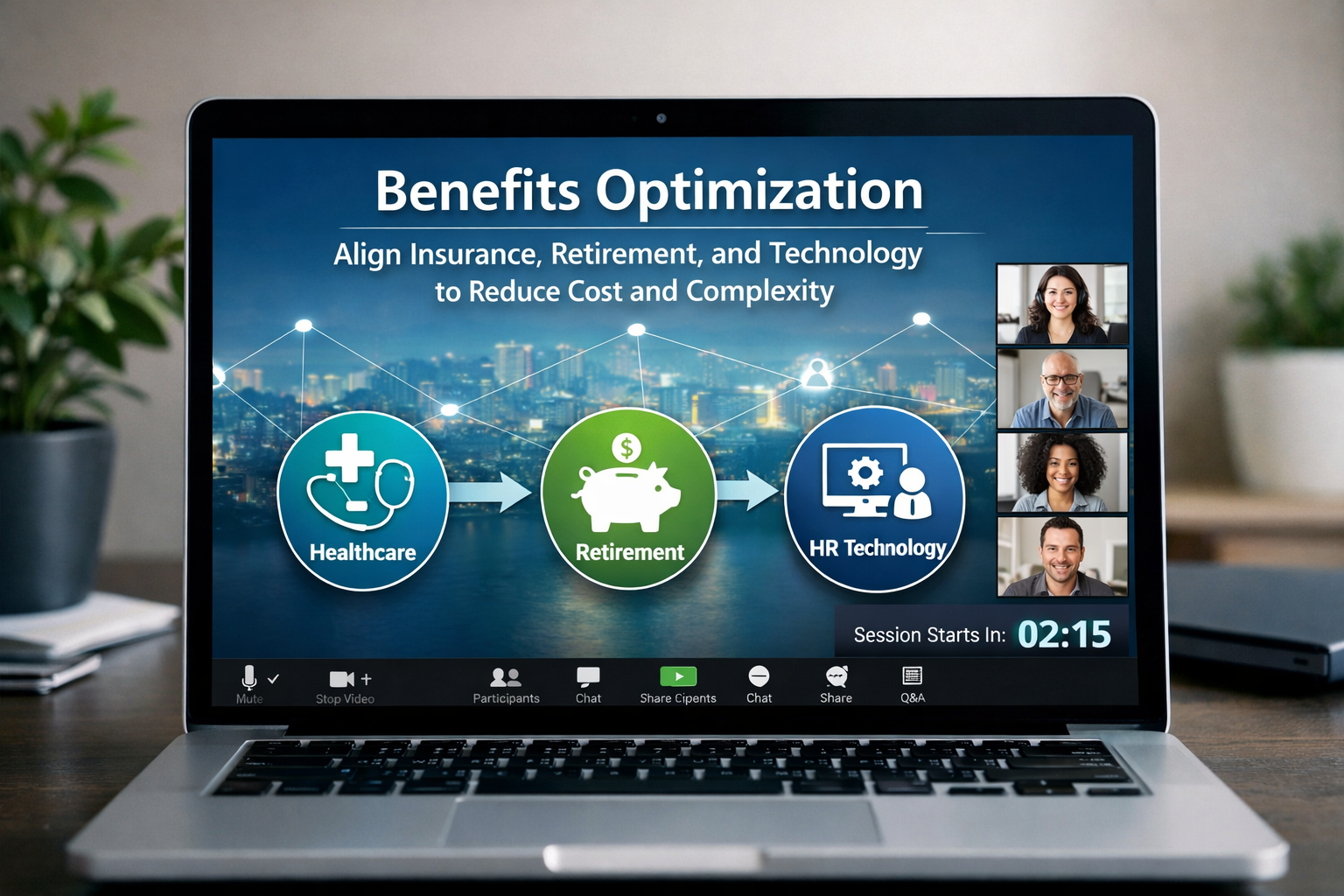
**Benefits Optimization: Align Insurance, Retirement, and Technology to Reduce Cost and Complexity** brings together three practitioners who each operate in a different part of this system, and who see firsthand where misalignment creates unnecessary cost and friction.
### Healthcare and Benefits Optimization
**[Blake Erickson](https://www.dspins.com/about-our-agency/meet-our-team/team-member/blake-erickson/), DSP Insurance Services**
Where employers overspend and why it is rarely visible. How plan design and funding decisions materially impact cost and risk. And critically, where healthcare decisions break down when they are not aligned with HR, finance, and retirement strategy.
### Retirement Optimization
**Michael Edward Sparrow, CFEd, WealthWave**
Improving participation and savings outcomes without increasing employer cost or complexity. Smart plan design, behavior change, and aligning retirement strategy with total rewards and retention.
### HRIS Optimization
**Nick Munagian, Paylocity**
Moving beyond payroll to system-level operational efficiency. Reducing system sprawl, improving adoption and employee experience, and using HR data to support leadership decision-making (without adding more tools).
## What You Will Walk Away With
In under an hour, you will leave with:
- A framework for optimizing benefits holistically, not piecemeal
- Clear examples of what actually drives savings and engagement
- Practical ideas you can evaluate immediately, with no vendor pressure
This is not a product pitch. It is a focused conversation about where the leverage actually lives when you stop managing healthcare, retirement, and technology as three separate line items.
We have explored how [AI is reshaping benefits strategy](https://blog.dspins.com/can-ai-make-benefits-better) and how evolving regulations like [mental health parity compliance](https://blog.dspins.com/proposed-changes-in-mental-health-parity-nqtl-requirements) add complexity to plan management. This session takes the next step: showing how to align the moving parts into a coordinated system.
## Who Should Attend
This session is built for the people making or influencing benefits decisions at mid-market organizations:
- **HR Leaders** managing cost, complexity, and employee expectations
- **CFOs** seeking predictability, control, and ROI from benefits spend
- **CHROs** responsible for total rewards and workforce strategy
- **Business owners and operations leaders** who want benefits to work harder without working them harder
## Reserve Your Seat
**Date:** Thursday, March 19, 2026
**Time:** 12:00 p.m. to 1:00 p.m. Central Time
**Format:** Live virtual session via Zoom
[Register here](https://info.dspins.com/benefits-optimization) to reserve your spot.
Questions ahead of the session? [Reach out to the DSP team](https://www.dspins.com/contact/) directly.
---
#### Tag:
[Employee Benefits](https://blog.dspins.com/tag/employee-benefits)
#### Share:
- [Follow us on Linkedin](http://www.linkedin.com/shareArticle?mini=true&url=https://blog.dspins.com/your-benefits-strategy-may-have-a-coordination-problem)
- [Follow us on Mail](mailto:?subject=Your%20Benefits%20Strategy%20May%20Have%20a%20Coordination%20Problem%20&%20body=https://blog.dspins.com/your-benefits-strategy-may-have-a-coordination-problem)
- Follow us on Copy Copied to clipboard
---
---
## Related Posts
It is a long established fact that a reader will be distracted by the readable content of a page when looking at its layout.
[Employee Benefits](https://blog.dspins.com/tag/employee-benefits)
[Blake Erickson](https://blog.dspins.com/author/blake-erickson) 14 July, 2026
#### [The Stop-Loss Attachment Point Buyer's Guide: How to Set the Number for 2027](https://blog.dspins.com/the-stop-loss-attachment-point-buyers-guide-how-to-set-the-number-for-2027)
If you self-fund, your specific stop-loss deductible is the single largest risk-transfer decision…
[Read More](https://blog.dspins.com/the-stop-loss-attachment-point-buyers-guide-how-to-set-the-number-for-2027)
[Employee Benefits](https://blog.dspins.com/tag/employee-benefits)
[DSP Insurance Services](https://blog.dspins.com/author/dsp-insurance-services) 11 June, 2026
#### [The Prescription Drug Machine: What Employers Need to Know About Rising Pharmacy Costs](https://blog.dspins.com/the-prescription-drug-machine-what-employers-need-to-know-about-rising-pharmacy-costs)
Prescription drug costs have become one of the fastest-growing expenses in employer-sponsored…
[Read More](https://blog.dspins.com/the-prescription-drug-machine-what-employers-need-to-know-about-rising-pharmacy-costs)
[Employee Benefits](https://blog.dspins.com/tag/employee-benefits)
[DSP Insurance Services](https://blog.dspins.com/author/dsp-insurance-services) 04 June, 2026
#### [BCBS Association Class Action Settlement](https://blog.dspins.com/bcbs-association-class-action-settlement)
In 2012 an “antitrust” class action suit was filed against the Nation’s 36 Blue Cross plans,…
[Read More](https://blog.dspins.com/bcbs-association-class-action-settlement)
- Insurance Solutions
- [Business Insurance](https://www.dspins.com/business-insurance/)
- [Insurance by Industry](https://www.dspins.com/business-insurance/insurance-by-industry/)
- [Employee Benefits](https://www.dspins.com/employee-benefits/)
- [Personal Insurance](https://www.dspins.com/personal-insurance/)
- [Explore Interactive Graphics](https://www.dspins.com/clickable-coverage/)
- [Safety Consulting](https://www.dspins.com/safety-consulting/)
- [Custom Insurance Benchmarking](https://www.dspins.com/custom-insurance-benchmarking/)
- About DSP Insurance Services
- [About Our Agency](https://www.dspins.com/about-our-agency/)
- [Meet Our Team](https://www.dspins.com/about-our-agency/meet-our-team/)
- [Read Our Reviews](https://www.dspins.com/about-our-agency/read-our-reviews/)
- [We Are Independent](https://www.dspins.com/about-our-agency/we-are-independent/)
- [Join Our Team](https://www.dspins.com/about-our-agency/join-our-team/)
- [Blog](https://www.dspins.com/blog/)
- Get Help
- [Report a Claim](https://www.dspins.com/service-center/report-a-claim/)
- [Request Auto ID Card](https://www.dspins.com/service-center/request-auto-id-card/)
- [Request a Certificate](https://www.dspins.com/service-center/request-certificate/)
- [Request a Bond](https://www.dspins.com/service-center/request-a-bond/)
- [Policy Review](https://www.dspins.com/service-center/policy-review/)
- [Request Policy Change](https://www.dspins.com/service-center/request-policy-change/)
- [Client Login](https://www.dspins.com/service-center/#client-login)
###### Contact Us
1900 E. Golf Road
Suite 650
Schaumburg, IL 60173
---
[info@dspins.com](mailto:info@dspins.com)
[847-934-6100](tel:847-934-6100)
847-934-6186 fax
[Contact Us](https://www.dspins.com/contact/)

### Experience the Value of an Independent Agency
---
Promising stability. Providing peace of mind. Caring about each client individually. This is more than what we do every day. It’s why we come in every day. Because at DSP Insurance Services, our future is yours.
We are licensed in the United States, Canada, and Mexico, as well as Europe, Asia, Australia, and around the globe.
© 2023 DSP Insurance Services | All rights reserved | [Privacy Policy](https://www.dspins.com/privacy-policy/)
World-class service and insurance solutions around the globe.
World-class service and insurance solutions around the globe.
World-class service and insurance solutions around the globe.
Insurance Solutions
847-934-6100