---
title: Your Team Is Using AI. Is Your Insurance Program Keeping Up?
description: As AI tools reshape industries, insurers are adapting coverage. Discover how to align your insurance with AI usage to avoid potential gaps.
image: https://blog.dspins.com/hubfs/DSP-ai-exclusions-featured-2b%20V2.png
---
[](https://www.dspins.com/)
- [Insurance Solutions](https://www.dspins.com/insurance-solutions/)
- [Business Insurance](https://www.dspins.com/business-insurance/)
- [Workers’ Compensation](https://www.dspins.com/business-insurance/workers-compensation-insurance/)
- [Directors and Officers Liability](https://www.dspins.com/business-insurance/directors-and-officers-liability-insurance/)
- [Employment Practice Liability](https://www.dspins.com/business-insurance/employment-practice-liability-insurance/)
- [See All](https://www.dspins.com/business-insurance/)
- [Employee Benefits](https://www.dspins.com/employee-benefits/)
- [Group Health](https://www.dspins.com/employee-benefits/group-health-insurance/)
- [Group Dental](https://www.dspins.com/employee-benefits/group-dental-insurance/)
- [Group Vision](https://www.dspins.com/employee-benefits/group-vision-insurance/)
- [See All](https://www.dspins.com/employee-benefits/)
- [Insurance by Industry](https://www.dspins.com/business-insurance/insurance-by-industry/)
- [Contractor](https://www.dspins.com/business-insurance/insurance-by-industry/contractor-insurance/)
- [Manufacturer](https://www.dspins.com/business-insurance/insurance-by-industry/manufacturer-insurance/)
- [Financial Institution](https://www.dspins.com/business-insurance/insurance-by-industry/financial-institution-insurance/)
- [See All](https://www.dspins.com/business-insurance/insurance-by-industry/)
- [Personal Insurance](https://www.dspins.com/personal-insurance/)
- [Home](https://www.dspins.com/personal-insurance/home-insurance/)
- [Auto](https://www.dspins.com/personal-insurance/auto-insurance/)
- [Umbrella](https://www.dspins.com/personal-insurance/umbrella-insurance/)
- [See All](https://www.dspins.com/personal-insurance/)
- [Safety Consulting](https://www.dspins.com/safety-consulting/)
- [Service Center](https://www.dspins.com/service-center/)
- [Explore Policy Options](https://www.dspins.com/service-center/)
- [Report a Claim](https://www.dspins.com/service-center/report-a-claim/)
- [Request Auto ID Card](https://www.dspins.com/service-center/request-auto-id-card/)
- [Request a Certificate](https://www.dspins.com/service-center/request-certificate/)
- [Request a Bond](https://www.dspins.com/service-center/report-a-claim/)
- [Policy Review](https://www.dspins.com/service-center/policy-review/)
- [Request Policy Change](https://www.dspins.com/service-center/request-policy-change/)
- [Client Login](https://www.dspins.com/service-center/#client-login)
- [Custom Insurance Benchmarking](https://www.dspins.com/custom-insurance-benchmarking/)
- [About](https://www.dspins.com/service-center/)
- [About Our Agency](https://blog.dspins.com/About%20Our%20Agency)
- [Agency News](https://www.dspins.com/blog/category/agency-news/)
- [Meet Our Team](https://www.dspins.com/about-our-agency/meet-our-team/)
- [Read Our Reviews](https://www.dspins.com/about-our-agency/read-our-reviews/)
- [We Are Independent](https://www.dspins.com/about-our-agency/we-are-independent/)
- [Community Involvement](https://www.dspins.com/about-our-agency/community-involvement/)
- [Join Our Team](https://www.dspins.com/about-our-agency/join-our-team/)
- [Learn About Our Agency](https://www.dspins.com/about-our-agency/)
- Media
- [Blog](https://blog.dspins.com/)
- [Podcast](https://www.dspins.com/podcast/)
- [Events](https://info.dspins.com/events)
- [Contact](https://www.dspins.com/contact/)
- [Schaumburg, IL Office](https://www.dspins.com/contact/schaumburg-il-insurance/)
- [1900 E. Golf Road Suite 650 Schaumburg, IL 60173](https://www.dspins.com/contact/schaumburg-il-insurance/)
- [847-934-6100](tel:847-934-6100)
- [info@dspins.com](https://blog.dspins.com/info@dspins.com)
- [Review Us](https://www.dspins.com/contact/review-us/)
- [Refer Us](https://www.dspins.com/contact/refer-us/)
- [Contact](https://www.dspins.com/contact/)
[847-934-6100](tel:847-934-6100)
[Request Quote](https://www.dspins.com/request-quote/)
*Menu*
- [Insurance Solutions](https://www.dspins.com/insurance-solutions/)
- [Safety Consulting](https://www.dspins.com/safety-consulting/)
- [Business Insurance](https://www.dspins.com/business-insurance/)
- [Workers’ Compensation](https://www.dspins.com/business-insurance/workers-compensation-insurance/)
- [Directors and Officers Liability](https://www.dspins.com/business-insurance/directors-and-officers-liability-insurance/)
- [Employment Practice Liability](https://www.dspins.com/business-insurance/employment-practice-liability-insurance/)
- [See All](https://www.dspins.com/business-insurance/)
- [Employee Benefits](https://www.dspins.com/employee-benefits/)
- [Group Health](https://www.dspins.com/employee-benefits/group-health-insurance/)
- [Group Dental](https://www.dspins.com/employee-benefits/group-dental-insurance/)
- [Group Vision](https://www.dspins.com/employee-benefits/group-vision-insurance/)
- [See All](https://www.dspins.com/employee-benefits/)
- [Insurance by Industry](https://www.dspins.com/business-insurance/insurance-by-industry/)
- [Contractor](https://www.dspins.com/business-insurance/insurance-by-industry/contractor-insurance/)
- [Manufacturer](https://www.dspins.com/business-insurance/insurance-by-industry/manufacturer-insurance/)
- [Financial Institution](https://www.dspins.com/business-insurance/insurance-by-industry/financial-institution-insurance/)
- [See All](https://www.dspins.com/business-insurance/insurance-by-industry/)
- [Personal Insurance](https://www.dspins.com/personal-insurance/)
- [Home](https://www.dspins.com/personal-insurance/home-insurance/)
- [Auto](https://www.dspins.com/personal-insurance/auto-insurance/)
- [Umbrella](https://www.dspins.com/personal-insurance/umbrella-insurance/)
- [See All](https://www.dspins.com/personal-insurance/)
- [Service Center](https://www.dspins.com/service-center/)
- [Explore Policy Options](https://www.dspins.com/service-center/)
- [Report a Claim](https://www.dspins.com/service-center/report-a-claim/)
- [Request Auto ID Card](https://www.dspins.com/service-center/request-auto-id-card/)
- [Request a Certificate](https://www.dspins.com/service-center/request-certificate/)
- [Request a Bond](https://www.dspins.com/service-center/report-a-claim/)
- [Policy Review](https://www.dspins.com/service-center/policy-review/)
- [Request Policy Change](https://www.dspins.com/service-center/request-policy-change/)
- [Client Login](https://www.dspins.com/service-center/#client-login)
- [Custom Insurance Benchmarking](https://www.dspins.com/custom-insurance-benchmarking/)
- [About](https://www.dspins.com/service-center/)
- [About Our Agency](https://blog.dspins.com/About%20Our%20Agency)
- [Agency News](https://www.dspins.com/blog/category/agency-news/)
- [Meet Our Team](https://www.dspins.com/about-our-agency/meet-our-team/)
- [Read Our Reviews](https://www.dspins.com/about-our-agency/read-our-reviews/)
- [We Are Independent](https://www.dspins.com/about-our-agency/we-are-independent/)
- [Community Involvement](https://www.dspins.com/about-our-agency/community-involvement/)
- [Join Our Team](https://www.dspins.com/about-our-agency/join-our-team/)
- [Learn About Our Agency](https://www.dspins.com/about-our-agency/)
- [Blog](https://www.dspins.com/blog/)
- [Events](https://info.dspins.com/events)
- [Contact](https://www.dspins.com/contact/)
- [Schaumburg, IL Office](https://www.dspins.com/contact/schaumburg-il-insurance/)
- [1900 E. Golf Road Suite 650 Schaumburg, IL 60173](https://www.dspins.com/contact/schaumburg-il-insurance/)
- [847-934-6100](tel:847-934-6100)
- [info@dspins.com](https://blog.dspins.com/info@dspins.com)
- [Review Us](https://www.dspins.com/contact/review-us/)
- [Refer Us](https://www.dspins.com/contact/refer-us/)
- [Contact](https://www.dspins.com/contact/)
- [847-934-6100](tel:847-934-6100)
- [Request Quote](https://www.dspins.com/request-quote/)
-
-
[DSP Insurance Services](https://blog.dspins.com/author/dsp-insurance-services) [Business Insurance](https://blog.dspins.com/tag/business-insurance)
4 Minutes
## Your Team Is Using AI. Is Your Insurance Program Keeping Up?
Your Team Is Using AI. Is Your Insurance Program Keeping Up?
7:17
AI-enabled tools are increasingly finding their way into businesses of all types, including manufacturing, construction, professional services, distribution and many others.
Companies are using AI for estimating, design support, technical work, marketing, project communications, research and administrative tasks.
At the same time, insurance carriers are beginning to change how they address those exposures.
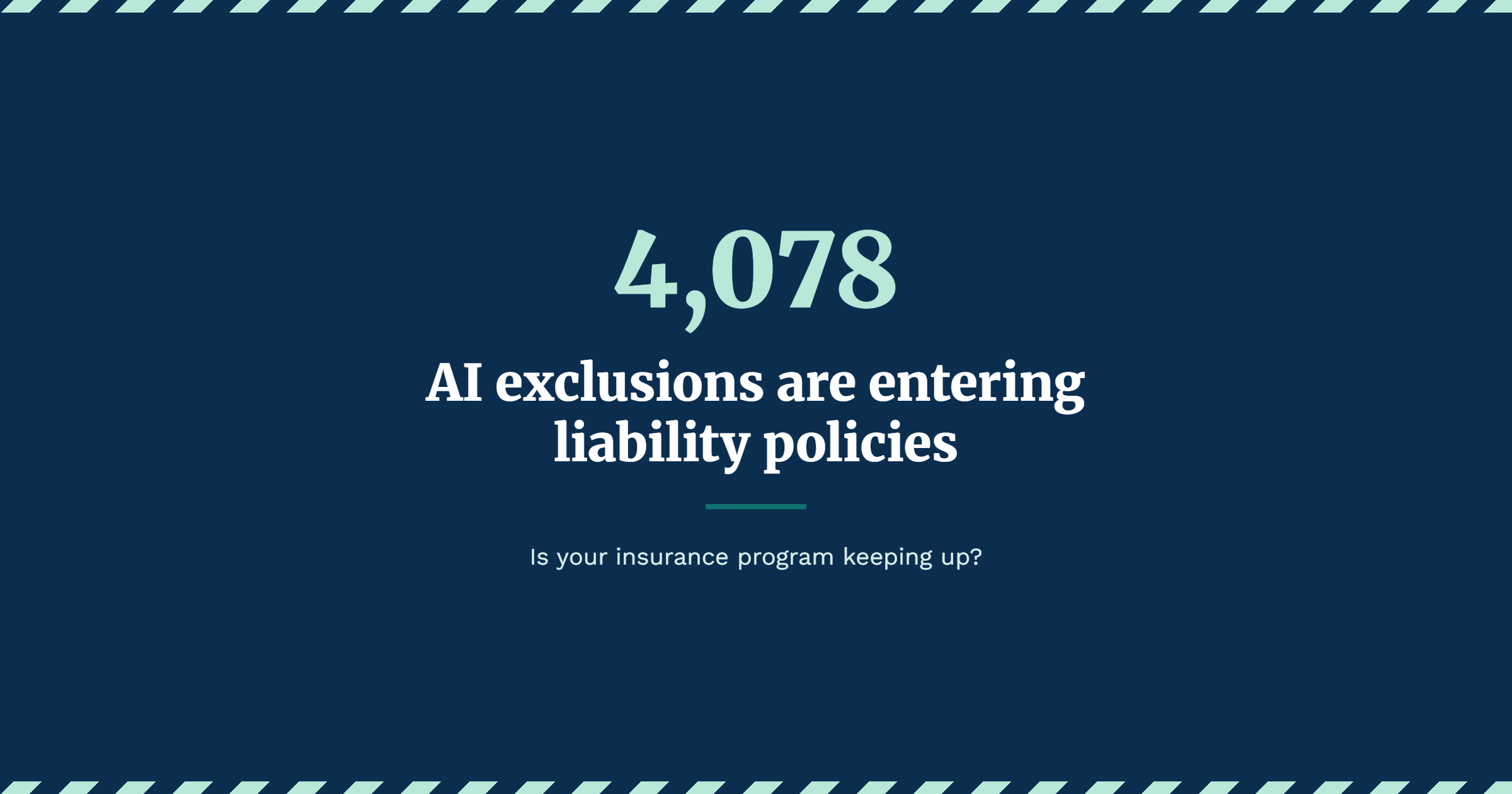
A nationwide analysis of public insurance filings published in August identified **4,078** filed form adoptions involving generative AI exclusions across 49 states and the District of Columbia through July 31, 2026. Of those, **2,369** had reached their filed effective dates. The analysis found that **3,955** of the 4,078 adoptions involved coverage lines businesses commonly purchase, including general liability, umbrella and excess liability, commercial package, businessowners and errors and omissions coverage. \[1\]
That does not mean these exclusions are already sitting on 2,369 individual policies. However, it does tell us that the insurance market is preparing to address AI differently.
And this is not a construction-specific issue.
The coverage forms involved are used across industries, which means manufacturers, distributors, professional services firms, contractors and other businesses should all be paying attention.
## Why should businesses care?
The Insurance Services Office, or ISO, has introduced several generative AI exclusion endorsements for commercial liability policies.
According to Verisk, one of the broadest, **CG 40 47**, excludes coverage for bodily injury, property damage and personal and advertising injury "arising out of" generative artificial intelligence. Other ISO forms address Coverage B and products and completed operations exposures. \[2\]
That creates an important question:
What happens when AI becomes part of the process that ultimately contributes to a loss?
Consider a few potential scenarios.
▸ A manufacturer uses AI to assist with product specifications, technical instructions or quality-related work and an error contributes to a product liability claim.
▸ A professional services firm uses AI to help prepare client work or recommendations that later become part of an errors and omissions allegation.
▸ A contractor relies on an AI-supported tool for an estimate, takeoff or design-related recommendation and an error contributes to a project loss.
▸ A marketing team uses AI-generated content that results in a copyright, defamation or advertising injury allegation.
These scenarios do not automatically mean coverage would be excluded. Coverage will depend on the specific facts, policy wording and applicable law.
But they show why businesses need to understand both where AI is being used and what their insurance policies say about it.
## The issue: AI adoption is happening faster than risk management
Many companies may have more AI usage than leadership realizes.
Employees are experimenting with generative AI tools. Existing software platforms are adding AI functionality. Engineers, estimators, project managers, marketers and administrative teams are finding ways to automate work and improve productivity.
Much of that adoption can happen organically rather than through a formal company-wide AI strategy.
That creates a potential disconnect.
Your people may be expanding their use of AI while your insurance carrier is simultaneously changing how it intends to cover losses involving AI.
That is something businesses should get ahead of now.
## What we recommend
✓ **Understand where AI is being used.**
Talk with operations, finance, marketing, IT, engineering, project management and other relevant teams. Identify which tools employees are using and where AI-generated output could influence products, services, recommendations, specifications, designs, safety decisions or completed work.
Higher-risk uses deserve more attention than routine administrative tasks.
✓ **Review your policies for new AI language.**
Do not assume your renewal policy is identical to last year's policy.
AI exclusions and limitations should become part of the review process for general liability, umbrella and excess liability, professional liability and other relevant coverages.
The important question is not simply whether an exclusion exists. It is how broadly it is written and how it interacts with the way your organization actually uses AI.
✓ **Review the full liability program.**
The primary policy is only one piece of the equation.
The August filing analysis identified generative AI exclusions across primary, umbrella and excess coverage. Businesses should review the language across the full liability program and understand whether the layers continue to work together as intended. \[1\]
✓ **Put basic guardrails around AI.**
A 50-page AI policy is not necessary. However, companies should have clarity around approved tools, appropriate uses, human review and situations where an AI-generated answer should not be relied upon without verification.
✓ **Make AI part of the renewal conversation.**
Your insurance advisor should understand how your company is using AI before approaching the marketplace.
This should become part of the normal operational discussion with your broker, just like changes in revenue, payroll, products, services, contracts, equipment or geographic expansion.
## Our view
AI is exciting, and used correctly, it can improve productivity, make teams more efficient and allow good people to spend more time on higher-value work. We are figuring this out in our own shop too.
But new technology and risk management need to move together.
The insurance market is already beginning to address generative AI exposure. The August filing analysis also found that the admitted-market filings it reviewed did not identify a standalone generative AI product that simply replaces the business coverage potentially removed by these exclusions. \[1\]
That makes policy wording and proactive review particularly important.
At DSP, our job is not to tell clients to avoid innovation, but rather to help make sure that as their businesses change, their insurance programs keep up.
If your company is expanding its use of AI, now is a good time to understand where it is being used, what your policies say and whether any new coverage gaps are developing.
Your DSP advisor can help you find out. Reach out before your next renewal.
## Sources
\[1\] Trades Coverage: "The AI Exclusion Hiding in Your Contractor Insurance," August 2026. Analysis of public SERFF and Florida I-File insurance filings through July 31, 2026.
\[2\] Insurance Journal: "Insurer Interest in AI Coverage Exclusions Growing as Risk Becomes Omnipresent," August 17, 2026. Includes Verisk's description of ISO generative AI endorsements CG 40 47, CG 40 48 and CG 35 08.
\[3\] Gallagher: "ISO Introduces Generative AI Exclusion in Commercial General Liability Policies: What Construction Companies Should Know," 2026. Used as a construction-specific example of how these exclusions may interact with AI-assisted estimating, scheduling, design support and project communications.
---
#### Tag:
[Business Insurance](https://blog.dspins.com/tag/business-insurance)
#### Share:
- [Follow us on Linkedin](http://www.linkedin.com/shareArticle?mini=true&url=https://blog.dspins.com/your-team-is-using-ai.-is-your-insurance-program-keeping-up)
- [Follow us on Mail](mailto:?subject=Your%20Team%20Is%20Using%20AI.%20Is%20Your%20Insurance%20Program%20Keeping%20Up?%20&%20body=https://blog.dspins.com/your-team-is-using-ai.-is-your-insurance-program-keeping-up)
- Follow us on Copy Copied to clipboard
---
---
## Related Posts
It is a long established fact that a reader will be distracted by the readable content of a page when looking at its layout.
[Business Insurance](https://blog.dspins.com/tag/business-insurance)
[DSP Insurance Services](https://blog.dspins.com/author/dsp-insurance-services) 20 August, 2026
#### [E-Bikes and E-Scooters: The Speed Is the Feature. It's Also the Risk.](https://blog.dspins.com/ebike-escooter-safety-check)
If you or your family ride an e-bike or e-scooter, the deductible on your judgment isn't the…
[Read More](https://blog.dspins.com/ebike-escooter-safety-check)
[Business Insurance](https://blog.dspins.com/tag/business-insurance)
[Mike Pohl](https://blog.dspins.com/author/mike-pohl) 13 August, 2026
#### [Employment Practices Liability Trends Employers Should Watch in 2026](https://blog.dspins.com/employment-practices-liability-trends-employers-should-watch-in-2026)
Employment practices liability risks are evolving as workplace regulations change, artificial…
[Read More](https://blog.dspins.com/employment-practices-liability-trends-employers-should-watch-in-2026)
[Business Insurance](https://blog.dspins.com/tag/business-insurance)
[DSP Insurance Services](https://blog.dspins.com/author/dsp-insurance-services) 22 July, 2026
#### [AI Changed Cybersecurity. Has Your Business Changed With It?](https://blog.dspins.com/ai-changed-cybersecurity.-has-your-business-changed-with-it)
Most business owners believe they've checked the cybersecurity box. They have an IT provider.…
[Read More](https://blog.dspins.com/ai-changed-cybersecurity.-has-your-business-changed-with-it)
- Insurance Solutions
- [Business Insurance](https://www.dspins.com/business-insurance/)
- [Insurance by Industry](https://www.dspins.com/business-insurance/insurance-by-industry/)
- [Employee Benefits](https://www.dspins.com/employee-benefits/)
- [Personal Insurance](https://www.dspins.com/personal-insurance/)
- [Explore Interactive Graphics](https://www.dspins.com/clickable-coverage/)
- [Safety Consulting](https://www.dspins.com/safety-consulting/)
- [Custom Insurance Benchmarking](https://www.dspins.com/custom-insurance-benchmarking/)
- About DSP Insurance Services
- [About Our Agency](https://www.dspins.com/about-our-agency/)
- [Meet Our Team](https://www.dspins.com/about-our-agency/meet-our-team/)
- [Read Our Reviews](https://www.dspins.com/about-our-agency/read-our-reviews/)
- [We Are Independent](https://www.dspins.com/about-our-agency/we-are-independent/)
- [Join Our Team](https://www.dspins.com/about-our-agency/join-our-team/)
- [Blog](https://www.dspins.com/blog/)
- Get Help
- [Report a Claim](https://www.dspins.com/service-center/report-a-claim/)
- [Request Auto ID Card](https://www.dspins.com/service-center/request-auto-id-card/)
- [Request a Certificate](https://www.dspins.com/service-center/request-certificate/)
- [Request a Bond](https://www.dspins.com/service-center/request-a-bond/)
- [Policy Review](https://www.dspins.com/service-center/policy-review/)
- [Request Policy Change](https://www.dspins.com/service-center/request-policy-change/)
- [Client Login](https://www.dspins.com/service-center/#client-login)
###### Contact Us
1900 E. Golf Road
Suite 650
Schaumburg, IL 60173
---
[info@dspins.com](mailto:info@dspins.com)
[847-934-6100](tel:847-934-6100)
847-934-6186 fax
[Contact Us](https://www.dspins.com/contact/)

### Experience the Value of an Independent Agency
---
Promising stability. Providing peace of mind. Caring about each client individually. This is more than what we do every day. It’s why we come in every day. Because at DSP Insurance Services, our future is yours.
We are licensed in the United States, Canada, and Mexico, as well as Europe, Asia, Australia, and around the globe.
© 2023 DSP Insurance Services | All rights reserved | [Privacy Policy](https://www.dspins.com/privacy-policy/)
World-class service and insurance solutions around the globe.
World-class service and insurance solutions around the globe.
World-class service and insurance solutions around the globe.
Insurance Solutions
847-934-6100