---
title: Employment Practices Liability Trends Employers Should Watch in 2026
description: 2026 employment practices liability trends include AI hiring risks, pay transparency, discrimination claims and evolving workplace regulations.
image: https://blog.dspins.com/hubfs/ChatGPT%20Image%20Aug%2012%2c%202026%2c%2001_30_45%20PM.png
---
[](https://www.dspins.com/)
- [Insurance Solutions](https://www.dspins.com/insurance-solutions/)
- [Business Insurance](https://www.dspins.com/business-insurance/)
- [Workers’ Compensation](https://www.dspins.com/business-insurance/workers-compensation-insurance/)
- [Directors and Officers Liability](https://www.dspins.com/business-insurance/directors-and-officers-liability-insurance/)
- [Employment Practice Liability](https://www.dspins.com/business-insurance/employment-practice-liability-insurance/)
- [See All](https://www.dspins.com/business-insurance/)
- [Employee Benefits](https://www.dspins.com/employee-benefits/)
- [Group Health](https://www.dspins.com/employee-benefits/group-health-insurance/)
- [Group Dental](https://www.dspins.com/employee-benefits/group-dental-insurance/)
- [Group Vision](https://www.dspins.com/employee-benefits/group-vision-insurance/)
- [See All](https://www.dspins.com/employee-benefits/)
- [Insurance by Industry](https://www.dspins.com/business-insurance/insurance-by-industry/)
- [Contractor](https://www.dspins.com/business-insurance/insurance-by-industry/contractor-insurance/)
- [Manufacturer](https://www.dspins.com/business-insurance/insurance-by-industry/manufacturer-insurance/)
- [Financial Institution](https://www.dspins.com/business-insurance/insurance-by-industry/financial-institution-insurance/)
- [See All](https://www.dspins.com/business-insurance/insurance-by-industry/)
- [Personal Insurance](https://www.dspins.com/personal-insurance/)
- [Home](https://www.dspins.com/personal-insurance/home-insurance/)
- [Auto](https://www.dspins.com/personal-insurance/auto-insurance/)
- [Umbrella](https://www.dspins.com/personal-insurance/umbrella-insurance/)
- [See All](https://www.dspins.com/personal-insurance/)
- [Safety Consulting](https://www.dspins.com/safety-consulting/)
- [Service Center](https://www.dspins.com/service-center/)
- [Explore Policy Options](https://www.dspins.com/service-center/)
- [Report a Claim](https://www.dspins.com/service-center/report-a-claim/)
- [Request Auto ID Card](https://www.dspins.com/service-center/request-auto-id-card/)
- [Request a Certificate](https://www.dspins.com/service-center/request-certificate/)
- [Request a Bond](https://www.dspins.com/service-center/report-a-claim/)
- [Policy Review](https://www.dspins.com/service-center/policy-review/)
- [Request Policy Change](https://www.dspins.com/service-center/request-policy-change/)
- [Client Login](https://www.dspins.com/service-center/#client-login)
- [Custom Insurance Benchmarking](https://www.dspins.com/custom-insurance-benchmarking/)
- [About](https://www.dspins.com/service-center/)
- [About Our Agency](https://blog.dspins.com/About%20Our%20Agency)
- [Agency News](https://www.dspins.com/blog/category/agency-news/)
- [Meet Our Team](https://www.dspins.com/about-our-agency/meet-our-team/)
- [Read Our Reviews](https://www.dspins.com/about-our-agency/read-our-reviews/)
- [We Are Independent](https://www.dspins.com/about-our-agency/we-are-independent/)
- [Community Involvement](https://www.dspins.com/about-our-agency/community-involvement/)
- [Join Our Team](https://www.dspins.com/about-our-agency/join-our-team/)
- [Learn About Our Agency](https://www.dspins.com/about-our-agency/)
- Media
- [Blog](https://blog.dspins.com/)
- [Podcast](https://www.dspins.com/podcast/)
- [Events](https://info.dspins.com/events)
- [Contact](https://www.dspins.com/contact/)
- [Schaumburg, IL Office](https://www.dspins.com/contact/schaumburg-il-insurance/)
- [1900 E. Golf Road Suite 650 Schaumburg, IL 60173](https://www.dspins.com/contact/schaumburg-il-insurance/)
- [847-934-6100](tel:847-934-6100)
- [info@dspins.com](https://blog.dspins.com/info@dspins.com)
- [Review Us](https://www.dspins.com/contact/review-us/)
- [Refer Us](https://www.dspins.com/contact/refer-us/)
- [Contact](https://www.dspins.com/contact/)
[847-934-6100](tel:847-934-6100)
[Request Quote](https://www.dspins.com/request-quote/)
*Menu*
- [Insurance Solutions](https://www.dspins.com/insurance-solutions/)
- [Safety Consulting](https://www.dspins.com/safety-consulting/)
- [Business Insurance](https://www.dspins.com/business-insurance/)
- [Workers’ Compensation](https://www.dspins.com/business-insurance/workers-compensation-insurance/)
- [Directors and Officers Liability](https://www.dspins.com/business-insurance/directors-and-officers-liability-insurance/)
- [Employment Practice Liability](https://www.dspins.com/business-insurance/employment-practice-liability-insurance/)
- [See All](https://www.dspins.com/business-insurance/)
- [Employee Benefits](https://www.dspins.com/employee-benefits/)
- [Group Health](https://www.dspins.com/employee-benefits/group-health-insurance/)
- [Group Dental](https://www.dspins.com/employee-benefits/group-dental-insurance/)
- [Group Vision](https://www.dspins.com/employee-benefits/group-vision-insurance/)
- [See All](https://www.dspins.com/employee-benefits/)
- [Insurance by Industry](https://www.dspins.com/business-insurance/insurance-by-industry/)
- [Contractor](https://www.dspins.com/business-insurance/insurance-by-industry/contractor-insurance/)
- [Manufacturer](https://www.dspins.com/business-insurance/insurance-by-industry/manufacturer-insurance/)
- [Financial Institution](https://www.dspins.com/business-insurance/insurance-by-industry/financial-institution-insurance/)
- [See All](https://www.dspins.com/business-insurance/insurance-by-industry/)
- [Personal Insurance](https://www.dspins.com/personal-insurance/)
- [Home](https://www.dspins.com/personal-insurance/home-insurance/)
- [Auto](https://www.dspins.com/personal-insurance/auto-insurance/)
- [Umbrella](https://www.dspins.com/personal-insurance/umbrella-insurance/)
- [See All](https://www.dspins.com/personal-insurance/)
- [Service Center](https://www.dspins.com/service-center/)
- [Explore Policy Options](https://www.dspins.com/service-center/)
- [Report a Claim](https://www.dspins.com/service-center/report-a-claim/)
- [Request Auto ID Card](https://www.dspins.com/service-center/request-auto-id-card/)
- [Request a Certificate](https://www.dspins.com/service-center/request-certificate/)
- [Request a Bond](https://www.dspins.com/service-center/report-a-claim/)
- [Policy Review](https://www.dspins.com/service-center/policy-review/)
- [Request Policy Change](https://www.dspins.com/service-center/request-policy-change/)
- [Client Login](https://www.dspins.com/service-center/#client-login)
- [Custom Insurance Benchmarking](https://www.dspins.com/custom-insurance-benchmarking/)
- [About](https://www.dspins.com/service-center/)
- [About Our Agency](https://blog.dspins.com/About%20Our%20Agency)
- [Agency News](https://www.dspins.com/blog/category/agency-news/)
- [Meet Our Team](https://www.dspins.com/about-our-agency/meet-our-team/)
- [Read Our Reviews](https://www.dspins.com/about-our-agency/read-our-reviews/)
- [We Are Independent](https://www.dspins.com/about-our-agency/we-are-independent/)
- [Community Involvement](https://www.dspins.com/about-our-agency/community-involvement/)
- [Join Our Team](https://www.dspins.com/about-our-agency/join-our-team/)
- [Learn About Our Agency](https://www.dspins.com/about-our-agency/)
- [Blog](https://www.dspins.com/blog/)
- [Events](https://info.dspins.com/events)
- [Contact](https://www.dspins.com/contact/)
- [Schaumburg, IL Office](https://www.dspins.com/contact/schaumburg-il-insurance/)
- [1900 E. Golf Road Suite 650 Schaumburg, IL 60173](https://www.dspins.com/contact/schaumburg-il-insurance/)
- [847-934-6100](tel:847-934-6100)
- [info@dspins.com](https://blog.dspins.com/info@dspins.com)
- [Review Us](https://www.dspins.com/contact/review-us/)
- [Refer Us](https://www.dspins.com/contact/refer-us/)
- [Contact](https://www.dspins.com/contact/)
- [847-934-6100](tel:847-934-6100)
- [Request Quote](https://www.dspins.com/request-quote/)
-
-
[Mike Pohl](https://blog.dspins.com/author/mike-pohl) [Business Insurance](https://blog.dspins.com/tag/business-insurance)
3 Minutes
## Employment Practices Liability Trends Employers Should Watch in 2026
Employment Practices Liability Trends Employers Should Watch in 2026
7:02
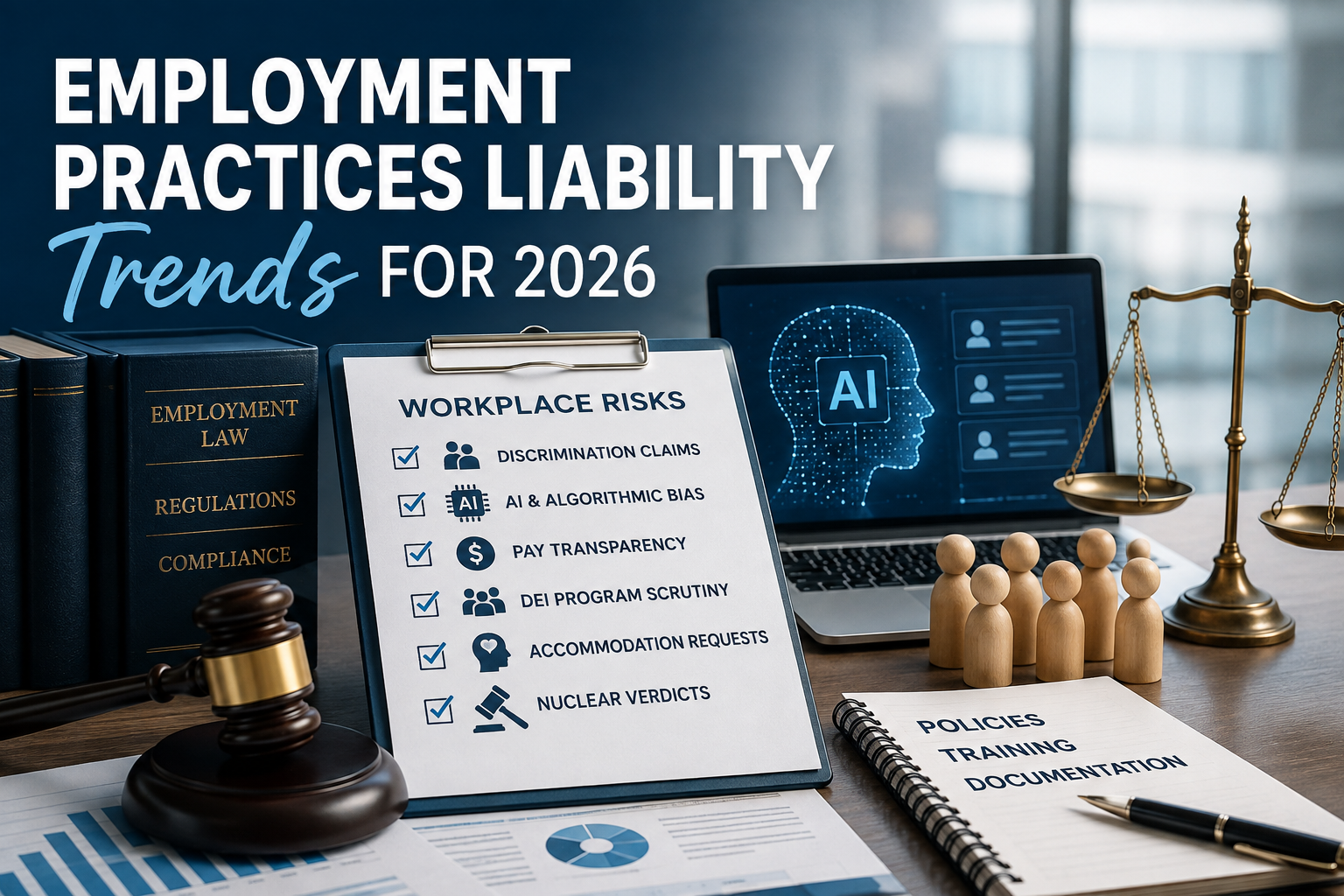
Employment practices liability risks are evolving as workplace regulations change, artificial intelligence becomes more integrated into HR decisions, and employees gain new protections. For employers, these changes can create greater exposure to discrimination claims, pay equity disputes, accommodation requests, and other employment-related litigation.
A recent [Zurich report on employment practices litigation trends for 2026](https://www.zurichna.com/knowledge/articles/2026/02/employment-practices-litigation-trends-for-2026) highlights several developments businesses should be watching.
## Employment-Related Litigation Continues to Rise
Employment-related lawsuits continue to create significant financial and reputational risks for organizations of all sizes.
According to Zurich, workplace discrimination charges filed with the Equal Employment Opportunity Commission (EEOC) increased in 2024. Systemic discrimination lawsuits also rose sharply, signaling an increasingly complex litigation environment for employers.
Strong employment policies, consistent documentation, and regular manager training can help organizations identify and address potential issues before they develop into larger claims.
## AI Is Creating New Employment Practices Risks
Artificial intelligence is becoming a bigger part of recruiting, hiring, performance management, and other employment decisions. While these tools can improve efficiency, they can also introduce new liability concerns.
For example, an AI-powered hiring tool could unintentionally disadvantage certain applicants based on how its algorithm evaluates candidates. Employers may face legal challenges if automated employment decisions result in discriminatory outcomes, even when the technology is provided by a third-party vendor.
New state regulations and developing court cases are also expanding the conversation around employer and AI vendor accountability.
Organizations using AI in employment decisions should understand how their tools operate, evaluate them for potential bias, maintain human oversight, and document how employment decisions are made.
## Pay Transparency and Pay Equity Remain Key Concerns
Pay transparency requirements continue to expand across the United States. More jurisdictions now require employers to disclose salary ranges or other compensation information in job postings.
At the same time, regulations such as the EU Pay Transparency Directive are increasing the focus on pay equity globally.
Employers should regularly review compensation practices, job descriptions, salary ranges, and job postings. Conducting periodic pay equity audits may also help identify inconsistencies before they become compliance or litigation issues.
## DEI Programs Face Changing Legal Scrutiny
Diversity, equity, and inclusion programs remain another evolving area of employment practices risk.
According to Zurich, employers are seeing increased scrutiny of workplace DEI policies along with reverse discrimination claims. This does not necessarily mean employers should abandon their programs. Instead, organizations should regularly review employment practices to ensure policies are lawful, consistently applied, and based on legitimate business considerations.
## Accommodation and Remote Work Requests Are Evolving
Employers are also navigating a growing range of accommodation requests, including those involving mental health conditions and remote or hybrid work arrangements.
Determining whether an accommodation is reasonable often requires an individualized review. Employers should have a consistent process for receiving requests, engaging in the interactive process, documenting decisions, and evaluating potential accommodations.
## Nuclear Verdicts Can Increase the Cost of Employment Claims
Another significant litigation trend is the continued rise of so-called "nuclear verdicts," generally referring to jury awards exceeding $10 million.
Large verdicts can significantly increase an organization's potential financial exposure and reinforce the importance of proactive employment practices risk management.
Clear policies, thorough documentation, effective manager training, and early response to employee concerns can all play a role in reducing risk.
## Does Traditional Insurance Cover AI-Related Liability?
Not always.
As businesses adopt artificial intelligence, they should also consider how their existing insurance policies respond to AI-related claims. Depending on the policy and circumstances, certain AI exposures may be excluded or may not fit neatly within traditional lines of coverage.
The insurance market is beginning to respond with products specifically designed for these emerging risks. For example, Amwins has developed an AI liability product that can provide buyback or stand-alone coverage in situations where AI liability is excluded from traditional insurance policies.
[**\[Download the Amwins Exclusive AI Liability Product Overview PDF\]**](https://blog.dspins.com/hubfs/Amwins_ExclusiveAI.pdf)
Coverage availability, eligibility, terms, conditions, and exclusions vary. Businesses should work with their insurance advisor to determine whether their existing policies adequately address their specific use of artificial intelligence.
## How Can Employers Reduce Employment Practices Liability Risk in 2026?
Employers can take several steps to better manage emerging employment practices risks:
- Review how AI is being used in hiring and other employment decisions.
- Evaluate AI tools for potential bias and maintain appropriate human oversight.
- Review compensation practices and applicable pay transparency requirements.
- Regularly evaluate employment and DEI policies for consistency and compliance.
- Strengthen processes for handling accommodation requests.
- Train managers on employment practices and proper documentation.
- Review Employment Practices Liability Insurance (EPLI) and other coverage for potential gaps involving emerging risks.
As employment practices and technology continue to evolve, organizations that take a proactive approach will be better positioned to reduce litigation exposure and respond when claims arise.
## Protecting Your Business as Employment Risks Evolve
Employment Practices Liability Insurance can help protect organizations against certain claims involving discrimination, harassment, wrongful termination, and other employment-related allegations. The growing use of artificial intelligence also creates risks that businesses should consider as part of their broader insurance and risk management strategy.
DSP Insurance can help your organization review its current coverage, identify potential gaps, and evaluate whether EPLI or emerging solutions such as AI liability coverage should be part of your risk management program.
[Contact DSP Insurance to discuss your organization's employment practices and AI liability exposures.](https://www.dspins.com/contact/#get-in-touch)
---
#### Tag:
[Business Insurance](https://blog.dspins.com/tag/business-insurance)
#### Share:
- [Follow us on Linkedin](http://www.linkedin.com/shareArticle?mini=true&url=https://blog.dspins.com/employment-practices-liability-trends-employers-should-watch-in-2026)
- [Follow us on Mail](mailto:?subject=Employment%20Practices%20Liability%20Trends%20Employers%20Should%20Watch%20in%202026%20&%20body=https://blog.dspins.com/employment-practices-liability-trends-employers-should-watch-in-2026)
- Follow us on Copy Copied to clipboard
---
---
## Related Posts
It is a long established fact that a reader will be distracted by the readable content of a page when looking at its layout.
[Business Insurance](https://blog.dspins.com/tag/business-insurance)
[DSP Insurance Services](https://blog.dspins.com/author/dsp-insurance-services) 22 July, 2026
#### [AI Changed Cybersecurity. Has Your Business Changed With It?](https://blog.dspins.com/ai-changed-cybersecurity.-has-your-business-changed-with-it)
Most business owners believe they've checked the cybersecurity box. They have an IT provider.…
[Read More](https://blog.dspins.com/ai-changed-cybersecurity.-has-your-business-changed-with-it)
[Business Insurance](https://blog.dspins.com/tag/business-insurance)
[Blake Erickson](https://blog.dspins.com/author/blake-erickson) 05 May, 2026
#### [Why Your Broker and CPA Should Be Working Together](https://blog.dspins.com/why-your-broker-and-cpa-should-be-working-together)
Most business owners don’t have a people problem. They have a communication problem. Not…
[Read More](https://blog.dspins.com/why-your-broker-and-cpa-should-be-working-together)
[Business Insurance](https://blog.dspins.com/tag/business-insurance)
[Mike Pohl](https://blog.dspins.com/author/mike-pohl) 24 April, 2026
#### [The Risk Management Center](https://blog.dspins.com/the-risk-management-center)
Most companies approach safety training the same way each year. They assign courses, send…
[Read More](https://blog.dspins.com/the-risk-management-center)
- Insurance Solutions
- [Business Insurance](https://www.dspins.com/business-insurance/)
- [Insurance by Industry](https://www.dspins.com/business-insurance/insurance-by-industry/)
- [Employee Benefits](https://www.dspins.com/employee-benefits/)
- [Personal Insurance](https://www.dspins.com/personal-insurance/)
- [Explore Interactive Graphics](https://www.dspins.com/clickable-coverage/)
- [Safety Consulting](https://www.dspins.com/safety-consulting/)
- [Custom Insurance Benchmarking](https://www.dspins.com/custom-insurance-benchmarking/)
- About DSP Insurance Services
- [About Our Agency](https://www.dspins.com/about-our-agency/)
- [Meet Our Team](https://www.dspins.com/about-our-agency/meet-our-team/)
- [Read Our Reviews](https://www.dspins.com/about-our-agency/read-our-reviews/)
- [We Are Independent](https://www.dspins.com/about-our-agency/we-are-independent/)
- [Join Our Team](https://www.dspins.com/about-our-agency/join-our-team/)
- [Blog](https://www.dspins.com/blog/)
- Get Help
- [Report a Claim](https://www.dspins.com/service-center/report-a-claim/)
- [Request Auto ID Card](https://www.dspins.com/service-center/request-auto-id-card/)
- [Request a Certificate](https://www.dspins.com/service-center/request-certificate/)
- [Request a Bond](https://www.dspins.com/service-center/request-a-bond/)
- [Policy Review](https://www.dspins.com/service-center/policy-review/)
- [Request Policy Change](https://www.dspins.com/service-center/request-policy-change/)
- [Client Login](https://www.dspins.com/service-center/#client-login)
###### Contact Us
1900 E. Golf Road
Suite 650
Schaumburg, IL 60173
---
[info@dspins.com](mailto:info@dspins.com)
[847-934-6100](tel:847-934-6100)
847-934-6186 fax
[Contact Us](https://www.dspins.com/contact/)

### Experience the Value of an Independent Agency
---
Promising stability. Providing peace of mind. Caring about each client individually. This is more than what we do every day. It’s why we come in every day. Because at DSP Insurance Services, our future is yours.
We are licensed in the United States, Canada, and Mexico, as well as Europe, Asia, Australia, and around the globe.
© 2023 DSP Insurance Services | All rights reserved | [Privacy Policy](https://www.dspins.com/privacy-policy/)
World-class service and insurance solutions around the globe.
World-class service and insurance solutions around the globe.
World-class service and insurance solutions around the globe.
Insurance Solutions
847-934-6100