
You See One Way Your PBM Gets Paid. The New Rule Shows You the Other Five.
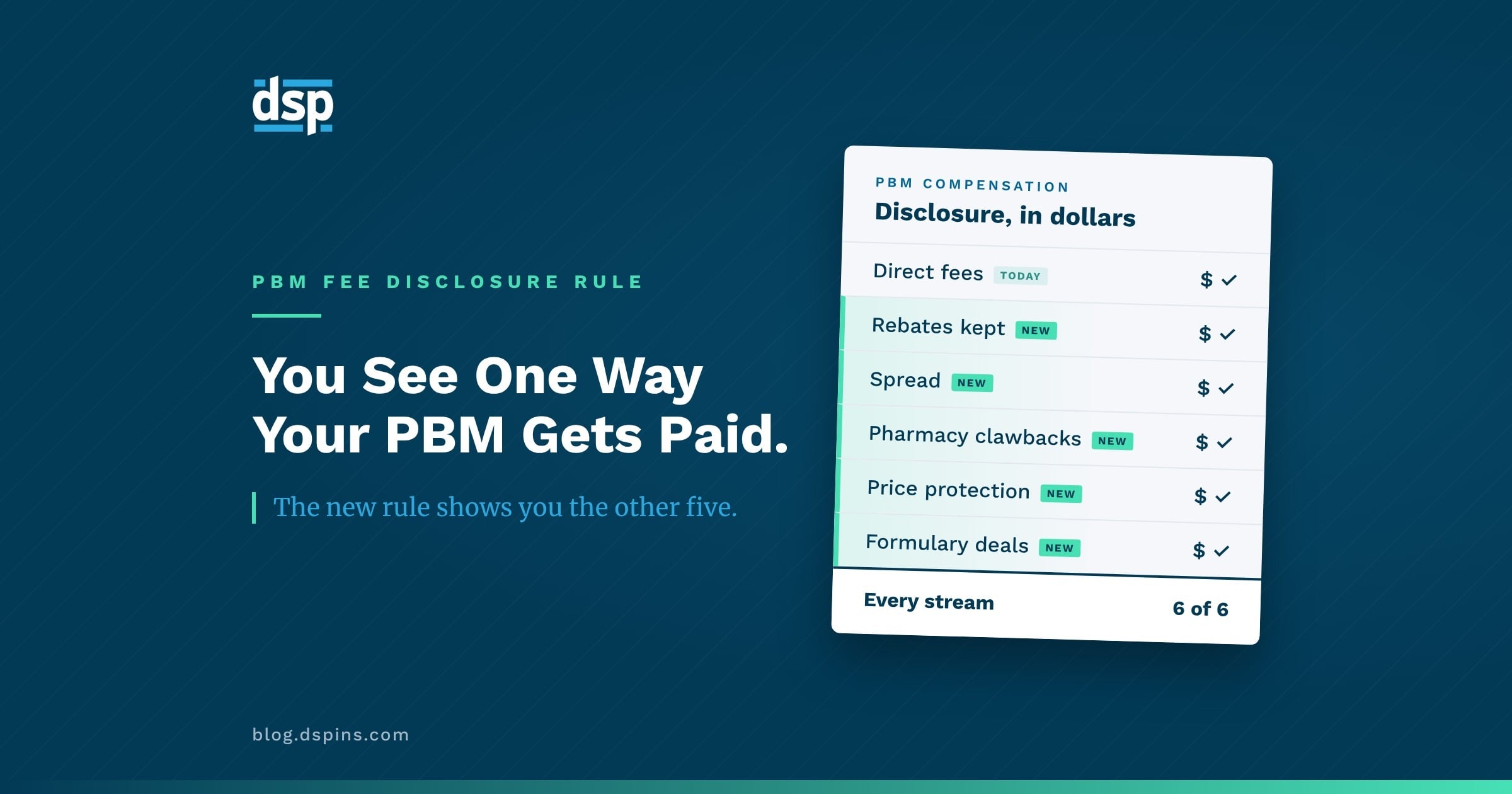
Every PBM contract has a line for what the plan pays the PBM. For most employers, that is the only number they ever see. The PBM gets paid at least five other ways, and until now, none of them had to show up on paper.
That is about to change. On October 29, the Department of Labor finalized a rule that makes pharmacy benefit managers disclose, in dollars, every way a self-funded health plan pays them. Level-funded plans count. The first disclosures reach employers in 2027.
Most coverage of the rule walks through what it requires. This article follows the money instead: the six ways a PBM gets paid, which of them you can see today, and where each one shows up once the rule applies to your plan.
Six Ways a PBM Gets Paid
A PBM sits between your plan, the pharmacies and the drug makers, and money moves in all three directions. (If you want the bigger picture on why pharmacy costs keep climbing, start with The Prescription Drug Machine.) Here is where the PBM's share comes from.
| 1. Direct fees Administrative fees the plan pays the PBM, per claim or per member. TODAY: In your contract 2027: Split out by service, in dollars | 2. Rebates Payments and fees from drug makers, tied to the drugs your plan covers. TODAY: The share the PBM keeps is hidden 2027: Drug by drug, what comes to the plan and what the PBM keeps |
| 3. Spread The PBM charges the plan more for a drug than it pays the pharmacy, and keeps the difference. TODAY: Built into the claim price 2027: The spread on each drug, at retail, mail order and specialty | 4. Clawbacks Money the PBM takes back from pharmacies after a claim is already paid. TODAY: Invisible to the plan 2027: Disclosed in dollars |
| 5. Price protection Payments from drug makers when list prices rise faster than an agreed limit. TODAY: Rarely reported 2027: Disclosed, with who keeps the money | 6. Formulary deals Payments tied to where a drug sits on your formulary, the list of drugs your plan covers. TODAY: Not shown 2027: The PBM names cheaper equivalents it left off, and says why |
| What you see today | ||||||
| Under the rule |
One of six revenue streams visible today. All six once the rule applies to your plan.
The rule also asks for the net price of every drug on the formulary, after rebates. That is the number that tells you what a drug really costs your plan, and it is the one most employers have never seen.
Follow One Prescription
Here is how three of those streams can hide inside a single generic prescription. The numbers are round and illustrative, chosen for clean arithmetic.
| The plan pays the PBM $40 for a generic prescription | ||
| $23Pharmacy keeps | $15Spread, kept by the PBM | $2 |
The PBM pays the pharmacy $25, keeps a $15 spread, and weeks later claws back $2 of the pharmacy's $25. Illustrative figures, not a benchmark.
On a claims report, that is a $40 generic. Nothing else shows. The PBM earned $17 on it, and the plan had no way to know. Under the rule, each of those three numbers gets its own line. Multiply one prescription by every fill in a plan year and you can see why the disclosure matters more than the headline fee.
Brand drugs work differently. There, the money usually moves through rebates and fees from the drug maker. The rule makes the PBM show, drug by drug, how much of that money came to your plan and how much it kept.
Three Documents, Three Different Jobs
The rule does not hand you one report. It hands you three, each on its own clock.
| DiscloseBefore every renewal or extension | What the PBM expects to make, in dollars. Not a formula, and not a discount off a list price nobody pays. Ninety days before renewal counts as reasonable timing. |
| ReportEvery six months, within 30 days | What the PBM actually made. You can ask for quarterly reports. Any category 5% or more over the estimate needs an explanation, and you can negotiate a lower trigger. |
| AuditAt least once a year | An auditor you choose checks the numbers. The PBM cannot limit who that is. It has 10 business days to confirm the request and 60 days to produce claims-level data and its contracts with pharmacies, drug makers and rebate aggregators, including data its affiliates hold. The plan pays the auditor. The PBM pays to pull the data. |
The report is where the disclosure gets tested. Here is the kind of comparison it makes possible.
| Six-month report (sample) | Estimated | Actual | Over |
| Direct fees | $180,000 | $182,400 | 1.3% |
| Rebates kept by the PBM | $60,000 | $71,400 | 19.0% |
| Spread | $45,000 | $46,800 | 4.0% |
| Pharmacy clawbacks | $8,000 | $8,300 | 3.8% |
Illustrative figures and layout. The rule sets what has to be reported, and the 5% trigger. The shaded row crosses it, so the PBM owes an explanation.
A row like the shaded one is the start of a conversation, not the end of one. Maybe a new drug launched and rebates rose with it. Maybe the PBM kept more of them than it promised. The explanation tells you which, and the audit lets you check it.
Does the Rule Apply to Your Plan?
It depends on two things: how the plan is funded, and how many employees the company has. Employees, not people on the plan. A company with 150 employees and 80 enrolled is in.
| Self-funded or level-funded 100 or more employees |
Full disclosure. Renewal disclosure, six-month reports and the annual audit, for plan years starting on or after July 1, 2027. In a level-funded plan, whoever contracts with the plan for pharmacy, a TPA or the carrier's level-funded product, has to get the PBM's numbers and pass them to you. |
| Self-funded or level-funded Fewer than 100 employees |
A shorter disclosure. The 2026 law still requires the PBM to report to you. It is simpler than the detailed version in the rule. |
| Fully insured Any size |
Left out, for now. DOL reserved this part of the rule. And when the law's rebate pass-through starts in 2028, a fully insured plan's rebates go to the insurance company, at least as the law reads today. |
That last row matters for a lot of mid-size employers. If you are fully insured with 100 or more employees, the rule is one more input to the funding conversation. A level-funded plan gets the disclosure. A fully insured plan does not.
When Does It Reach Your Desk?
Two dates confuse people. The law took effect in February 2026, so part of this is already owed. The detailed rule starts later, on your plan year.
| Feb 3, 2026 | The law is signed. Your PBM, your administrator and your broker owe you a disclosure of what they are paid, starting now. DOL is enforcing it on a good-faith basis while the market catches up. |
| Oct 29, 2026 | DOL announces the final rule. |
| Jan 4, 2027 | The rule takes effect. |
| About Apr 2027 | First disclosures for July 1 plans, about 90 days before renewal. |
| Jul 1, 2027 | The rule applies to plan years starting on or after this date. |
| About Oct 2027 | First disclosures for calendar-year plans, whose first plan year under the rule starts January 1, 2028. |
| Aug 3, 2028 | For plan years starting on or after this date, the law requires PBMs to pass 100% of rebates, fees and discounts through to the plan. |
"About" dates assume the disclosure arrives 90 days before renewal, the timing DOL calls reasonable.
Watch the contract term. Many PBM contracts run three years. One signed this year can run straight into the rule, and its own definitions of "rebate" and "spread" will decide what the plan gets until then.
What the Rule Does Not Do
It does not ban anything. The rule says plainly that it does not prohibit spread pricing. It does not set prices or cap fees. Deciding whether the PBM's pay is reasonable is still the plan fiduciary's job.
Every number in the disclosure also comes from the PBM. That is why the audit right is the most important part of the rule. DOL's own analysis notes the risk that PBMs find new ways to be paid outside what gets disclosed.
Keep the savings in perspective, too. DOL says the rule could lower drug costs by up to $22 billion over 10 years. That is the top of its range. Its primary estimate works out to about $8 billion. The savings go to plans that read the disclosure and act on it.
A disclosure that sits in a drawer does not protect the plan. It only proves the plan had the information.
What to Do With the Disclosure
A disclosure is a document. It does not lower a single claim on its own. The value comes from reading it against the contract and acting on what it shows.
- Ask now. The law already requires a compensation disclosure from your PBM, your administrator and your broker. Ask each one for it in writing. That includes us.
- Count back 90 days. Find your renewal date and put the disclosure date on the calendar. If the contract renews before the rule applies to your plan, write the rule's terms into it now: dollars, drug by drug, quarterly reports, a data file you can analyze, an overage trigger below 5%, and audit rights spelled out.
- Compare promised with paid. When the six-month report arrives, line it up against the renewal disclosure. Any category that ran over needs a reason you can accept.
- Price what the PBM keeps. Retained rebates, spread and clawbacks are compensation. Put them next to the market for the same services before deciding the deal is reasonable.
- Write it down. Record what you reviewed, what you decided and why. That record is what shows the plan was managed in its members' best interest.
- If the disclosure never comes, ask the PBM in writing to fix it. If it has not within 90 days, notify DOL within 30 days after that, then decide whether to keep the PBM and document why.
Get a second set of eyes on your first disclosure.DSP's employee benefits team helps self-funded and level-funded employers read PBM disclosures against their contracts, write the rule's terms into renewals, and decide when an audit is worth running. If you are fully insured and wondering whether the rule should change how you fund your plan, that is a conversation worth having before your next renewal. Talk to Our Benefits Team Explore Employee Benefits Or call 847-934-6100 | info@dspins.com |
Sources
- Employee Benefits Security Administration, Improving Transparency Into Pharmacy Benefit Manager Fee Disclosure, final rule, 91 FR 69092 (November 2, 2026), 29 CFR 2550.408b-22.
- U.S. Department of Labor, Fact Sheet: Pharmacy Benefit Manager Fee Disclosure Final Rule (October 2026). Coverage, timing and good-faith enforcement.
- U.S. Department of Labor, news release on the final rule (October 29, 2026). Savings estimate.
- Consolidated Appropriations Act, 2026, sections 6701 and 6702 (signed February 3, 2026). Disclosure duty and the rebate pass-through.
This article is for educational purposes and reflects the final rule and public information as of November 2026. It is not legal, tax, actuarial, or insurance advice. The prescription and report figures are illustrative, chosen for arithmetic clarity, not benchmarks for any specific plan.