
$380,664 in Proposed OSHA Fines: What One Illinois Trench Citation Teaches Every Contractor
Trenching and excavation work remains one of the most hazardous jobs in construction, and OSHA is making sure contractors don't forget it. In October 2026, the U.S. Department of Labor proposed $380,664 in penalties against a utility contractor based in Frankfort, Illinois, after investigators found employees working in an unprotected trench more than eight feet deep.
The case is a clear example of where OSHA's attention is focused right now, and why "we were only in there for a few minutes" is not a defense. Here's what happened, what OSHA requires, and what contractors can do to protect their crews and their business.
Key takeaways
- OSHA continues to enforce trench safety through its National Emphasis Program on Trenching and Excavation.
- Trenches 5 feet deep or more generally require a protective system: sloping, shoring, or shielding.
- Repeat violations carry the steepest penalties, which is why this Illinois case reached $380,664.
- The real cost of a cave-in goes far beyond the fine.
What Happened in Frankfort, Illinois
OSHA opened the inspection under its National Emphasis Program on Trenching after investigators observed employees working in a trench more than eight feet deep with no cave-in protection. The contractor was cited for:
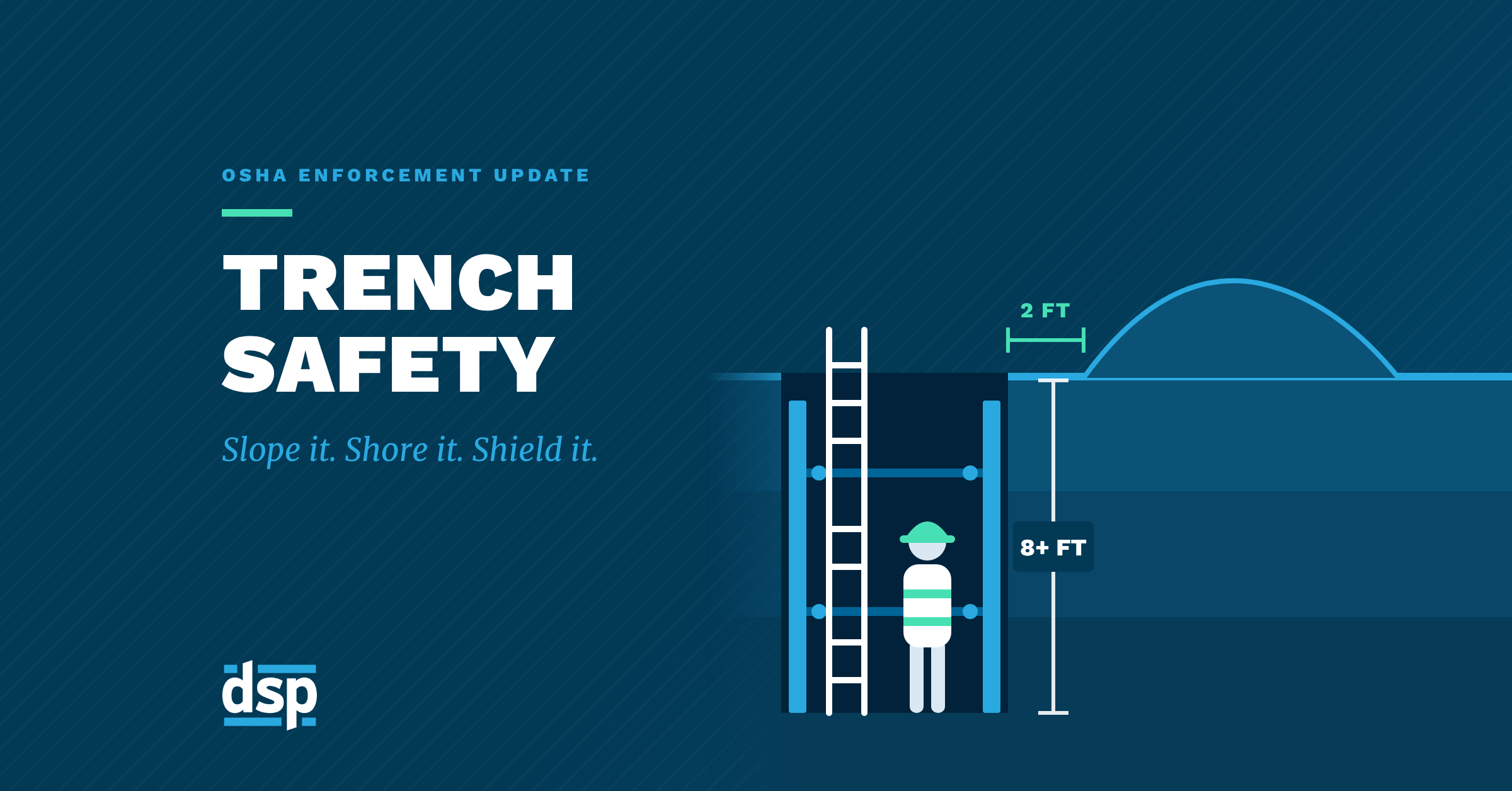
- Three repeat violations for failing to provide a safe means of exit from the trench, failing to install an adequate protective system to prevent cave-ins, and failing to keep excavated materials and equipment at least two feet from the trench edge.
- One serious violation for failing to provide head protection against falling objects.
$380,664
Total proposed OSHA penalties for three repeat violations and one serious violation tied to a single unprotected trench
U.S. Department of Labor, via Insurance Journal, October 2026
The word that drives the number is "repeat." OSHA issues a repeat citation when an employer has been cited for the same or a substantially similar hazard within the past five years, and repeat violations carry penalties many times higher than a standard serious citation.
Slope It. Shore It. Shield It.
OSHA's trench safety message comes down to three options. Any trench 5 feet deep or more needs at least one of them unless it is dug entirely in stable rock. Trenches 20 feet deep or more require a protective system designed by a registered professional engineer.
- Slope it. Cut the trench walls back at an angle away from the excavation. The required angle depends on soil type.
- Shore it. Install supports, such as hydraulic or timber shoring, to hold the trench walls in place and prevent soil movement.
- Shield it. Use trench boxes or other shields that protect workers inside if the walls do collapse.
Why this matters: a single cubic yard of soil can weigh as much as a small car. A worker caught in even a partial collapse has very little chance of getting out without serious injury, and there is often no time to react.
The Trench Safety Checklist OSHA Expects You to Follow
Every item OSHA cited in the Illinois case is covered by long-standing, well-known requirements. Before anyone enters a trench, confirm:
- A protective system is in place for any trench 5 feet deep or more.
- Safe access and exit is provided (ladders, steps, or ramps) in trenches 4 feet deep or more, within 25 feet of lateral travel for every worker.
- Spoil piles and equipment are kept at least 2 feet back from the trench edge.
- A competent person inspects the trench daily, before each shift, and after rain or any event that could increase the hazard. DSP offers Excavation Competent Person Training for crews that need it.
- Water accumulation is controlled, and no one works in a trench with standing water unless proper precautions are taken.
- The atmosphere is tested for low oxygen or hazardous gases where those conditions could exist.
- Underground utilities are located before digging begins.
- Hard hats and other required PPE are worn by everyone in and around the excavation.
The Cost Goes Well Beyond the Fine
A six-figure OSHA penalty gets attention, but it is rarely the most expensive part of a trench incident. For contractors, the business impact can include:
- Workers' compensation claims and a higher experience modification rate (EMR), which can raise premiums for years.
- Lost bids, since many owners and general contractors screen subcontractors on EMR and OSHA history.
- Liability exposure if a collapse damages nearby property, utilities, or roadways.
- Surety scrutiny, as repeat safety violations can raise questions about how a company manages risk.
- Project delays and stop-work orders while incidents are investigated.
And most importantly, trench collapses are among the most likely construction incidents to result in a fatality. No penalty or premium compares to that loss.
Frequently Asked Questions
When does OSHA require a trench protective system?
Generally, any trench 5 feet deep or more requires sloping, shoring, or shielding unless it is made entirely in stable rock. Shallower trenches may also need protection if a competent person identifies a cave-in hazard.
What is OSHA's National Emphasis Program on Trenching and Excavation?
It is an enforcement initiative that directs OSHA inspectors to prioritize trenching and excavation sites. Inspectors can open an inspection when they observe an open trench, even without a complaint.
What is a repeat OSHA violation?
A repeat violation is issued when an employer has previously been cited for the same or a substantially similar hazard within the last five years. Repeat violations carry significantly higher penalties than serious violations.
How far must spoil piles be from a trench?
Excavated materials and equipment must be kept at least 2 feet from the edge of the trench, or held back with retaining devices.
Who is a "competent person" for trenching?
A competent person is someone trained to identify existing and predictable hazards, including soil types and protective system requirements, and who has the authority to take immediate corrective action.
How can I find out if my jobsite would pass an OSHA inspection?
A mock OSHA inspection walks your site the way an inspector would and flags hazards before they turn into citations. DSP clients can register for a free mock OSHA inspection with Safety Steve.
The bottom line
The Illinois citation was not about new or complicated rules. Protective systems, safe exits, spoil pile setbacks, and hard hats are trench safety basics. OSHA is actively looking for open trenches, and contractors who skip the basics face steep penalties along with the far greater risk of losing a worker.
Get Ahead of OSHA with Safety Steve
DSP Insurance Services' safety consultant, Safety Steve, helps contractors build safer jobsites through on-site training, mock OSHA inspections, and practical guidance, including Excavation Competent Person Training. Visit our OSHA Compliance and Job Site Safety Training page to register for a free mock OSHA inspection or schedule training for your crews.